The 1995 Toyota RAV4 was a real game changer as the first small SUV to use a car-like unitized chassis. Its success prompted numerous other compact crossovers including the Honda CR-V and Ford Escape. But, as they became more popular, the RAV4 faded. It just didn’t evolve enough to stay ahead of rivals. Well, Toyota is out to change that for 2013 with an all new RAV4. So, let’s see if we can now rave about the RAV.
The first change you’ll see in the 2013 Toyota RAV4 is one you can’t see, anymore at least. The spare tire that used to be mounted on the “love-it-or-hate-it” side swinging rear door is no more. In its place is a more conventional lift-gate with the spare tire moved inside, under the cargo floor.
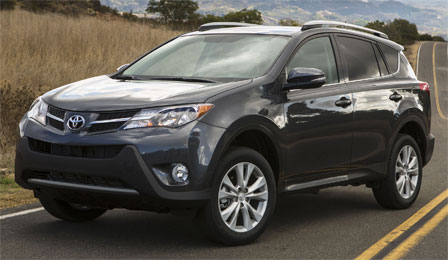
 It’s part of a whole new, if more conventional look that is sleeker and more athletic than previous RAVs. The expressive front end leads to a more steeply raked windshield; while roof rails on XLE models progress to a large hatch-mounted spoiler. Tail lights jut out from the rear fenders and the concave lines of the rear hatch give a very modern look. XLE’s come equipped with 18-inch alloys, but even the base 17-inch steel wheels with hubcaps look pretty sharp.
Not surprisingly, aerodynamics are greatly improved over the last RAV thanks to the slicker shape, new underbody covers, and front “aero” corners. Exterior dimensions are all down a bit from last year, mostly due to the removal of the outside spare; except for wheelbase which remains at 104.7-inches.
And while it’s doubtful many RAV owners will venture off pavement, with the optional all-wheel drive system, it performs well in slop and snow. AWD includes an electronic locking center diff for true 50/50 torque split at speeds up to 25 miles-per-hour; and can help dial back under-steer at any speed, thanks to new dynamic torque control.
The MacPherson strut front suspension and trailing arm double wishbone rear do a good job of soaking up bumps. And when back on dry pavement, a larger stabilizer bar helps reduce roll. Combined with fairly responsive electric steering, the RAV has a more solid, if not necessarily sportier, ride than before.
 It’s also delivers a very quiet driving environment, and you can now tailor the driving experience to your liking with ECO and Sport modes. ECO dials back the a/c and throttle response, while Sport boosts throttle response, changes both when and how quickly the transmission shifts, and makes steering feel more direct.
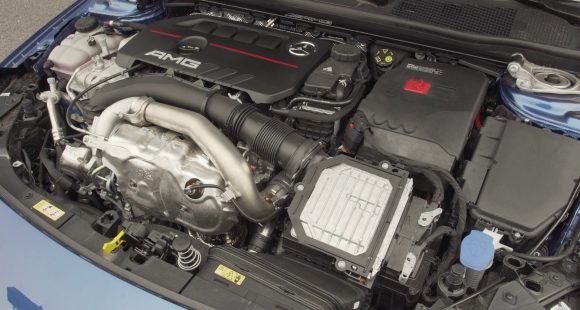
The sole engine is a carryover 2.5-liter I4 rated at 176-horsepower and 172 lb-ft. of torque. The V-6 is no more. The automatic transmission however, is upgraded from an antiquated 4-gears to 6, contributing to both a peppier feel and a 7-8 percent rise in fuel economy.
Indeed, Government Fuel Economy Ratings are 22–City, 29-Highway, and 25-Combined with all-wheel-drive, while front drivers rate 24-City, 31-Highway, and 26-Combined, all on regular grade gas.
The redesigned interior is where the new RAV4 makes its biggest strides. Replacing the drab living space of before is a good blend of both sporty feel and increased refinement; with a wide, soft-touch dash splitting the comfort and work zones, and lending an almost cockpit feel.
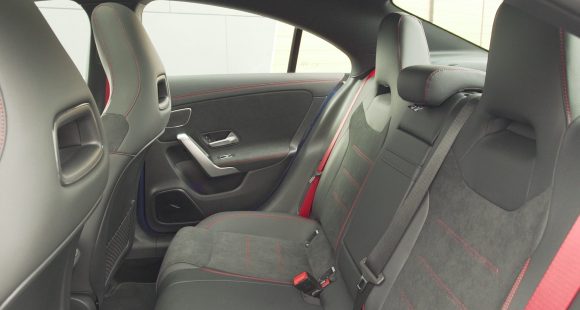
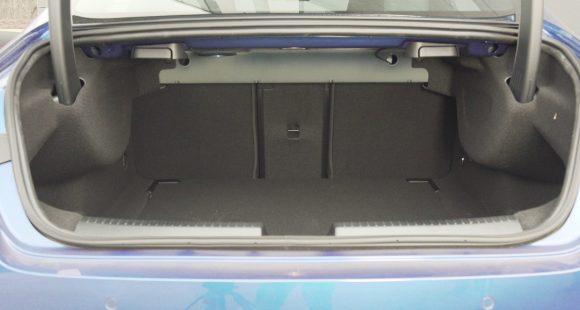
 Front seats are wide and much more comfortable than before. And even though exterior size is a bit smaller, everything is roomier inside, most noticeably in the back seat where legroom now rivals many mid-sizers, and in the cargo area where you’ll find 38.4 cubic feet of space with the seats up. Fold them, which is easier than before, and it expands to a class best 73.4 cubic-ft.
A back-up camera is standard, while blind spot monitoring can be added to Limited models, which come with a power rear lift-gate. Also standard are 8-airbags, including one for the driver’s knees.
Prices are up, but just barely so, and still a strong point. Trim levels have also been simplified to make the buying process easier, and that process begins at $24,145 for a base LE model. A mid-level XLE will cost you $25,135 and the loaded up Limited stickers for $27,855. All-wheel-drive can be added to any model for an additional 14-hundred bucks.
Change always has the potential to be good or bad. Well, in the RAV4’s case it is good and much needed. Buyers looking at the new RAV4 will find a roomier, more comfortable, more efficient, and yes, better looking compact crossover. That’s why we picked the 2013 Toyota RAV4 as our MotorWeek Drivers’ Choice Best Small Utility of the year. Just one more reason that there’s plenty to rave about the new RAV4!
Specifications
- Engine: 2.5-liter I4
- Horsepower: 176
- Torque: 172 lb-ft.
- EPA: 22 mpg city/ 29 mpg highway
Long Term Updates
Mileage: 6,000It’s one thing to give a new design an award, like we did the all-new Toyota RAV4, our Drivers’ Choice Best Small Utility of the Year, and it’s something else to live with it day-in and day-out just like real owners.
Well, so far, day-in and day-out, our long term RAV4 is living up to our hype. After about 6 weeks with us, the odometer is nearing 6,000 miles, and average fuel economy is an outstanding 29.2 miles per gallon of regular. That’s mostly highway work but even around town it’s solidly in the mid-twenties.
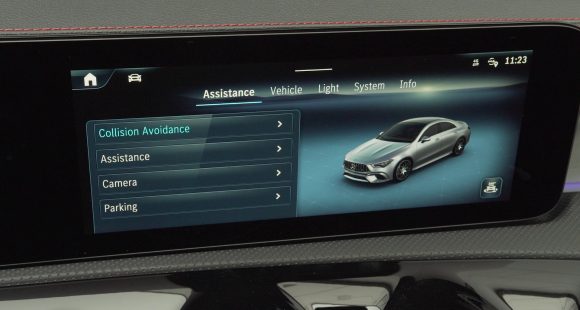
Our five-passenger Limited is nicely decked out, including seat memory and navigation, although the touch screen is a bit small. We like that the start button is not hidden behind the steering wheel. In Sport Mode, the RAV4’s 176-horsepower 2.5-liter I4 engine with 6-speed automatic delivers surprisingly big power for passing. But, switch to ECO MODE and the skinny pedal on the right almost goes numb.
The latest RAV4 is a huge improvement and we’re enjoying every mile we log in it.
Mileage: 8,000There is no more competitive vehicle segment than the compact crossover utility. So, for us to proclaim the redesigned Toyota RAV 4 our Drivers’ Choice Best, is saying something.
Bigger and more versatile than before, our long term, all-wheel drive 2013 RAV 4, in Limited trim, is exceeding even our expectations in comfort, utility, and even economy. In ECO mode we’re averaging 27.3 miles per gallon of regular after two months of the daily grind. And that’s pretty impressive.
The odometer has passed 8,000 miles and there has been nary of hiccup in quality. A few lament the loss of a third row option in the new design, but it really wasn’t that useful.
So our raves for the RAV4 continue.
Mileage: 11,500Almost daily we’re asked about our time with this Toyota RAV4 compact crossover.
We respond with praise for the 5-seat RAV4’s reliability, practical room for people and cargo, and a driving experience that borders on sporty.
Fuel economy is a big reason smaller utilities are in high demand. We’re averaging 25.5 miles per gallon of regular in a decent mix of city and highway driving.
Also, in four months and some 11,500-miles, there has not been a hint of a mechanical problem.
Mileage: 12,000It’s been almost a year since we picked the 2013 Toyota RV4 as our Driver’s Choice Best Small Utility. And, we’re happy to say, we’re still happy with our choice after living with a “RAV” for 6 months and some 12,000 miles.
It’s roomy, comfortable, and versatile in routine use. It also drive’s nicely, is well controlled with good energy, and quite quiet at speed. Plus, it’s been trouble free.
The test fuel economy average of 24.7 miles per gallon of regular in mostly urban driving is decent, and right on with the government’s combined number.
Our Limited all-wheel driver is very well equipped, and we generally rate Toyota’s EnTune touch audio/nav interface with embedded Apps as most effective.
Indeed, from push button start to an adjustable height power hatch, if you like gizmos in a rock solid compact ute, the Toyota RAV4 is a great choice.
Mileage: 18,200Boy, if ever there was a winter to test the mettle of an all-wheel drive utility this one is it. It’s not just the snow, but the radiator freezing cold. Fortunately, our long term 2013 Toyota RAV4 has made quick work of all of it.
We can attest to the fact that once you hit the push button start, the heater and defroster warm rapidly. And, when set on “High”, our Limited’s rock hard heated seats get almost too hot.
Cold also tends to expose weak mechanical links in a vehicle. But, at 8 months and 18,200 miles our RAV4 hasn’t revealed a single one.
More cold weather idling was offset by more time on the highway. So, our fuel economy average of 27.2 miles per gallon of regular pleased us plenty.
And that’s our feeling overall. The Toyota RAV4 is a roomy, versatile, and most important in winter weather, reliable compact CUV choice.
Mileage: 20,000We really loved having a Toyota RAV4 in our long term fleet during the never ending winter of 2014. It made quick work of the coldest driving conditions.
Now, that spring is here, a few upcoming road trips will also test the RAV4’s warm weather versatility. Besides a comfortable cabin for four adults, along with plenty of room for their gear, the competent all-wheel drive system in the RAV4 can tackle unimproved roads easily. Plus, if it gets muddy, a locking center diff should help ensure forward travel.
And you can do it pretty frugally. 26.9 miles per gallon of regular after 9 months and 20,000 miles speaks well for a 2.5-liter powered compact crossover. Plus, our RAV4 has been mechanically fault free.
Mileage: 23,000When you have to go the ute-route, the Toyota RAV4 is a great way to do it.
Not too big; not too small, the RAV4 can haul a growing family and lots of gear to just about anywhere four-wheels should go. When the going does get tough, a locking center differential keeps things moving.
Fuel economy is about right for a compact utility these days, 26.1 miles per gallon of regular after 11 months and 23,000 miles. The 2.5-liter I4 never misses a beat.
Inside, it’s quiet, comfortable, if a little utilitarian. Well that’s our RAV4, and it’s just as it should be.
Mileage: 24,000The Toyota RAV4 certainly adheres to the Goldilocks’ Principle of being “Not too big and not too small, but just right!” In size and capacity that is, but also in the way it drives.
Despite its compact size, the RAV4 has plenty of room for a family of five and most everything they need to carry with them.
Moreover, the RAV4 has a very controlled ride that is neither soft nor harsh, but you get that. What you may not expect is the competent way it handles the road. It’s not a sports car but it is a very enjoyable way to go most anywhere
Fuel economy is about right too, at 26.0 miles per gallon of regular after 14 months and 24,000 miles. The 2.5-liter I4 is one of the smoothest of its size, making the RAV4 anything but a fairytale machine.